Fire Pit vs Outdoor Fireplace: Which Is Right for Your Charlotte Backyard?
Comparing fire pits and outdoor fireplaces for Charlotte homes. Cost, maintenance, ambiance, and functionality to help you choose the best fire feature.
Michael Carter
You know how a standard patio can feel a bit empty once the sun goes down. A dedicated fire feature transforms that space into a true evening destination, leading to the ultimate question: Fire Pit vs Outdoor Fireplace: Which Is Right for Your Charlotte Backyard?
Our team of Charlotte outdoor kitchen professionals consistently hears this exact debate from clients looking to upgrade their space. We know this choice dictates entirely how you will use your outdoor living area.
The distinction goes far beyond just looks and basic budget constraints. Our guide breaks down the hard data on the most critical factors:
- Average 2026 installation costs
- Strict spatial requirements
- Long-term maintenance realities
Let’s look at the facts and find the perfect heating solution for your property.
Understanding the Fundamental Differences
Our clients often assume these two features serve the exact same purpose. The reality is they create completely different social dynamics.
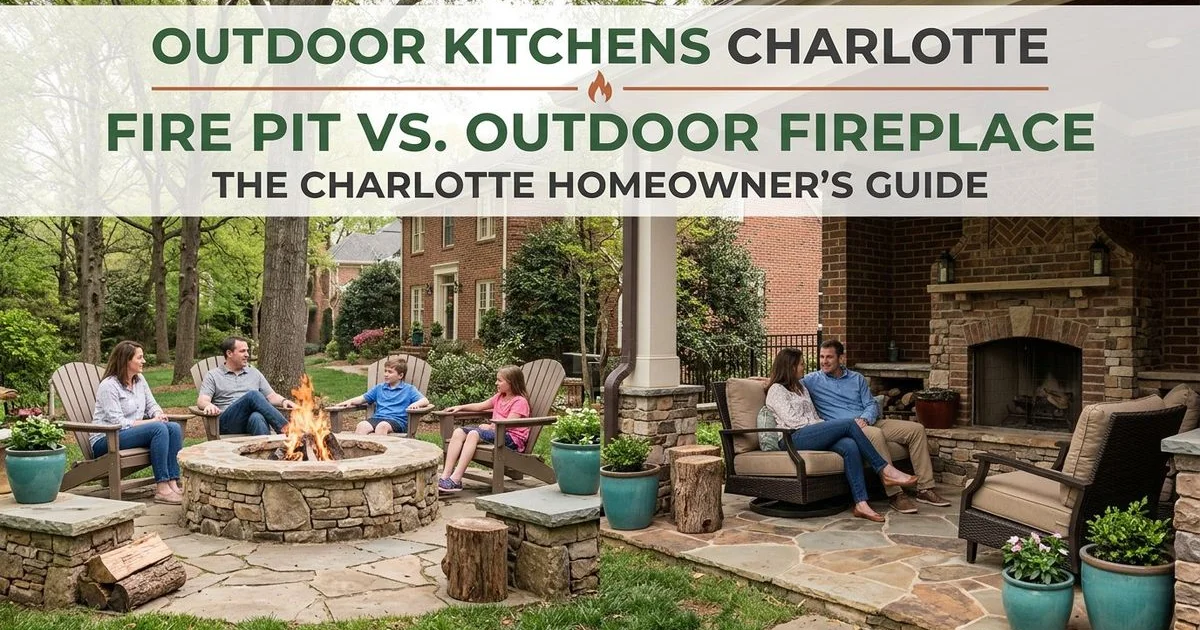
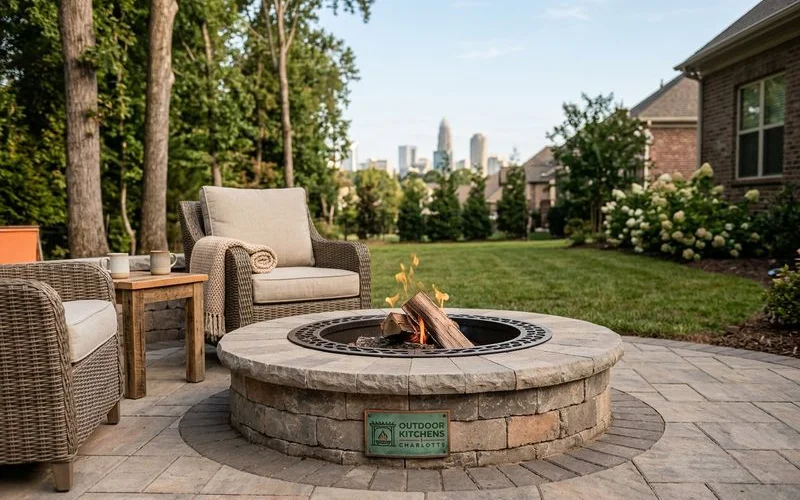
A fire pit is an open fire container that usually sits at or slightly above ground level. These structures radiate heat in a full 360-degree circle, naturally encouraging guests to gather around all sides.
We install options ranging from simple stone rings to elaborate custom builds featuring high-performance components. Upgrading to a premium Warming Trends CROSSFIRE brass burner, for instance, delivers a significantly taller and brighter flame than standard stainless steel rings.
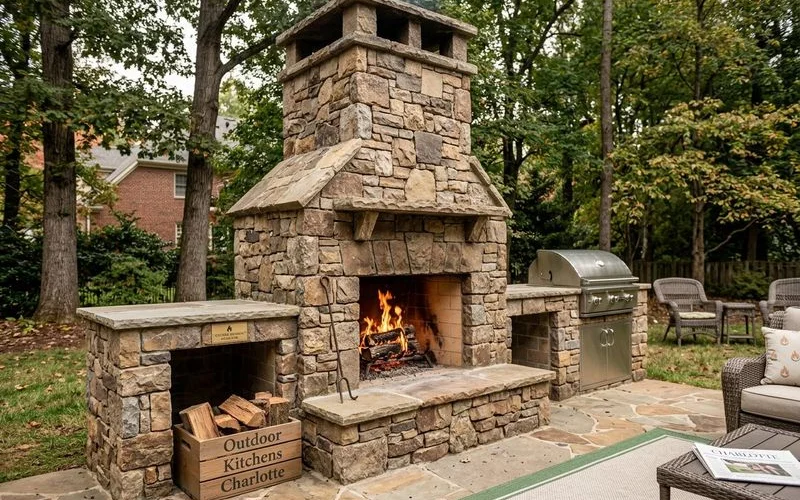
An outdoor fireplace functions as a vertical structure complete with a firebox, a chimney, and usually a hearth. This design directs heat forward in a single direction while channeling smoke up and away from your guests.
Our designers frequently use outdoor fireplaces to make a bold architectural statement. They anchor an outdoor living space and define the boundaries of your patio.
You can customize either feature with specific materials to match your home:
- Techo-Bloc Pavers: Excellent for creating modern, seamless matching walls.
- Corten Steel: Provides a trendy, weathered industrial look for fire pits.
- Natural Fieldstone: Delivers a classic, rustic aesthetic popular in the Carolinas.
The fundamental difference lies in how people interact. A fire pit serves as a communal gathering spot that invites eye contact and casual conversation. An outdoor fireplace creates a structured seating arrangement where everyone faces the warm glow.
Cost Comparison for Charlotte Homeowners
Budget frequently drives the final decision, and fire pits offer a much lower barrier to entry.
Our 2026 project data shows that standard pre-fabricated fire pits cost between $300 and $1,000 for materials and basic setup. Custom-built stone or brick fire pits with dedicated gas lines run between $3,000 and $8,000 across the US, depending on complexity.
We see high-end fire pit installations easily reaching $10,000 to $15,000. These premium setups include surrounding seating walls, integrated LED lighting, and high-quality fire glass.
Outdoor Fireplace Investment
Outdoor fireplaces require a substantially higher investment due to their sheer size and structural demands. A basic prefabricated outdoor fireplace kit, like those from Belgard, starts at $2,500 to $5,000 for the unit alone.
Our installation teams typically add another $2,000 to $5,000 in labor for these standard kits. Custom-built masonry fireplaces range from $8,000 to $20,000 for a standard design in 2026.
You will quickly exceed $30,000 if you want elaborate extensions like deep hearths, built-in television mounts, or premium stonework. The cost difference heavily reflects the required materials and specialized labor.
Average 2026 Installation Costs
We put together this quick reference guide based on recent local estimates:
| Fire Feature Type | Base Material Cost | Professional Installation | Total Estimated Range |
|---|---|---|---|
| Basic Fire Pit | $300 - $1,000 | $200 - $500 | $500 - $1,500 |
| Custom Gas Fire Pit | $1,500 - $3,500 | $1,500 - $4,500 | $3,000 - $8,000 |
| Prefab Fireplace Kit | $2,500 - $5,000 | $2,000 - $5,000 | $4,500 - $10,000 |
| Custom Masonry Fireplace | $4,000 - $8,000 | $4,000 - $12,000 | $8,000 - $20,000+ |
An outdoor fireplace needs a poured concrete foundation, fire-rated masonry, a proper flue lining, and massive amounts of brick or stone. The chimney alone accounts for roughly 30 to 40 percent of the total fireplace budget.
We strongly recommend getting site-specific quotes before finalizing your plans. Consulting with outdoor fireplace and fire pit specialists provides accurate pricing based on your unique yard grading and design goals.
Heat Output and Comfort in Charlotte’s Climate
Charlotte’s mild winters make both options highly practical for extending your outdoor season. They distribute heat differently, which directly impacts your comfort depending on your seating arrangement.
Our typical January weather brings average low temperatures down into the 30s. A standard natural gas fire pit generates between 30,000 and 60,000 BTUs, which easily cuts through that winter chill.
The 360-Degree Experience
Fire pits radiate this heat in all directions, warming everyone seated around the perimeter. This 360-degree distribution is highly efficient for group gatherings where guests sit in a tight circle.
We must warn you about a common drawback with open designs. Heat dissipates rapidly in open air, and sudden wind gusts will blow smoke toward anyone sitting on the downwind side. During breezy Carolina evenings, managing smoke around a wood-burning fire pit can quickly become an annoyance.
The Directional Heat Advantage
Outdoor fireplaces direct heat strictly forward toward the main seating area while channeling smoke up through the chimney. This directional heat is intensely focused for those seated directly in front, but it provides almost zero warmth to the sides or rear.
Our clients absolutely love the built-in draft of a chimney system. The upward pull virtually eliminates smoke at the seating level, giving you a huge comfort advantage when wind directions shift.
Either feature provides more than enough warmth for comfortable outdoor gatherings from October right through April. You can create a genuinely cozy outdoor environment even during the coldest weeks by combining a high-BTU gas burner with a covered patio structure.
Space Requirements and Layout Impact
Your backyard’s total size and existing layout play a massive role in determining the right fit.
Our planning phase always begins with a careful measurement of usable square footage. Fire pits are significantly more space-efficient and work beautifully in compact areas.
A standard 36 to 48-inch fire pit requires a total gathering area of approximately 12 by 12 feet to ensure comfortable seating. The industry standard suggests leaving 24 to 30 inches of clear walking space between the fire feature and your patio chairs.
We appreciate how fire pits serve as standalone features placed away from other structures. This freestanding nature gives you immense flexibility when designing your landscape paths.
Planning for Vertical Structures
Outdoor fireplaces require substantially more room primarily because of their imposing height and deep footprint. A typical outdoor fireplace structure measures 6 to 8 feet wide, 3 to 4 feet deep, and stretches 8 to 12 feet tall.
Our designs usually allocate a minimum space of 14 by 16 feet just to accommodate the fireplace and front seating area. The structure itself creates a solid visual wall that effectively divides the backyard.
This division works perfectly if you want to create distinct outdoor rooms for lounging and dining. Keep these spacing guidelines in mind:
- Fire Pits: Require a 12x12 foot minimum area and 24 to 30 inches of chair clearance.
- Outdoor Fireplaces: Demand at least 14x16 feet for the structure and forward seating.
- Kitchen Proximity: Place fire pits 10 to 20 feet away to separate the zones.
A massive masonry wall can feel restrictive in a smaller yard where you want to maintain an open, airy flow.
We frequently integrate outdoor fireplaces directly into the primary kitchen pavilion design. Positioning a fireplace at one end of a covered structure serves as a beautiful transition into a dedicated lounge zone.
Maintenance and Safety Considerations
Both fire features demand regular upkeep, but the specific tasks differ wildly.
Our maintenance crews consider fire pits to be the much easier option to manage. You simply need to clean out the ash after every few uses for a wood-burning pit and inspect the stone surround annually for hairline cracks.
Gas fire pits require even less physical labor to maintain throughout the year. You must perform a periodic burner inspection, wash the decorative fire glass, and verify that all gas connections remain tight.
Chimney Care and Best Practices
Outdoor fireplace maintenance involves significantly more work because of the active chimney system. The Chimney Safety Institute of America (CSIA) strongly recommends an annual inspection, or sweeping the flue whenever there is a 1/8-inch buildup of soot.
We advise hiring a certified sweep to check for dangerous creosote buildup, mortar deterioration, or hidden animal nests. Gas outdoor fireplaces skip the creosote issue, but they still require a yearly professional inspection of the burner components.
Safety clearances dictate exactly where you can build either feature. Mecklenburg County fire codes mandate that recreational fire pits must stay at least 25 feet away from any structure or combustible material. Our experts always remind clients to check their firewood before tossing it in. Using a digital moisture meter ensures your wood sits between 15% and 25% moisture, which prevents excessive smoke and dangerous creosote accumulation.
Permitting in Mecklenburg County
Understanding local regulations requires careful attention before you pour any concrete. Both fire pits and outdoor fireplaces generally require some level of permitting depending on their size and fuel source.
Our permit coordinators handle these applications daily for local residents. Portable fire pits that sit on existing patios usually bypass the permit requirement, provided they comply with open burning regulations.
Built-in fire pits with permanent gas lines require a specific mechanical trade permit for the gas installation. They must also strictly adhere to local fire code setback requirements.
We always secure a full building permit for outdoor fireplaces due to their permanent nature. The county scrutinizes the foundation depth, the final chimney height, and the structure’s potential impact on the property line.
The Inspection Process
The official permitting process involves a detailed plan review, an open-trench foundation inspection, and a final sign-off. Many local Homeowner Associations (HOAs) also demand a separate architectural review before construction begins.
Our team knows that working with experienced outdoor fireplace and fire pit professionals simplifies this entire ordeal. They manage the permit applications, ensure code compliance, and schedule the necessary county inspections on your behalf.
Fire Pit vs Outdoor Fireplace: Which Is Right for Your Charlotte Backyard?
Choosing the perfect fire feature comes down to matching the structure with your lifestyle goals.
Our design process focuses heavily on how you actually intend to host guests. A smart choice depends entirely on matching the feature to your typical weekend routine:
- Choose a Fire Pit If: You love casual, communal gatherings, have a tighter budget, or want to roast marshmallows with the kids.
- Choose a Fireplace If: You want a dramatic architectural focal point, hate dealing with blowing smoke, or plan to mount an outdoor television.
- Choose Both If: You have a sprawling backyard and want distinct zones for dining and late-night lounging.
We see many homeowners opting for a dual-feature approach to maximize their property’s potential. They install a grand fireplace next to the covered dining area and place a relaxed fire pit further out in the yard.
This strategy creates unique outdoor rooms customized for different moods and activities. You guarantee year-round usage of your entire landscape by providing multiple gathering spaces.
Our top priority is ensuring your new installation adds lasting value and safety to your home. Reach out to experienced outdoor fireplace and fire pit builders to discuss your vision and pinpoint the best solution for your space.
Transform Your Charlotte Backyard Today
Upgrading your outdoor living space with a custom feature guarantees better evenings at home. When deciding on a Fire Pit vs Outdoor Fireplace: Which Is Right for Your Charlotte Backyard?, the best choice seamlessly blends your aesthetic preferences with the practical realities of your property.
Our team is ready to help you finalize your layout and select the perfect materials.
Start your project by scheduling a professional site evaluation today.
Michael Carter
Outdoor Living Design Specialist
15+ years designing outdoor kitchens across Charlotte, NC.