How to Plan Plumbing and Gas Lines for Your Outdoor Kitchen
A homeowner's guide to planning plumbing and gas line installation for outdoor kitchens. Safety requirements, costs, and what to expect during installation.
Michael Carter
Planning the utility backbone for a custom outdoor setup is often the most overlooked phase of the project.
We see homeowners focus entirely on the aesthetic finishes. They completely forget that the invisible pipes dictate what appliances actually work.
This guide covers how to plan plumbing and gas lines for your outdoor kitchen correctly from day one. Our goal is to help you avoid expensive teardowns later.
You will learn the exact codes, 2026 costs, and safety protocols required to build a functional and safe cooking space.
Planning Your Gas Line Installation
Natural gas is the preferred fuel source for most outdoor grills and burners in Charlotte. When building outdoor kitchens in Charlotte, proper gas line planning is one of the first steps our team addresses.
We recommend natural gas because it provides an unlimited fuel supply with no interruptions. Planning the gas line early in the design process is essential. The route and capacity affect the layout of your entire kitchen.
To size the line correctly, you must calculate the total BTU demand. We add up the requirements of every single appliance. A typical built-in gas grill uses between 40,000 and 80,000 BTUs.
High-end models often require 75 to 100 BTUs per square inch of cooking space to maintain consistent heat. Our planners also factor in side burners, which add 12,000 to 15,000 BTUs. A gas fireplace uses 40,000 to 60,000 BTUs, and a pizza oven can demand another 50,000.
Add up all the appliances you plan to install and provide this total to your gas contractor.
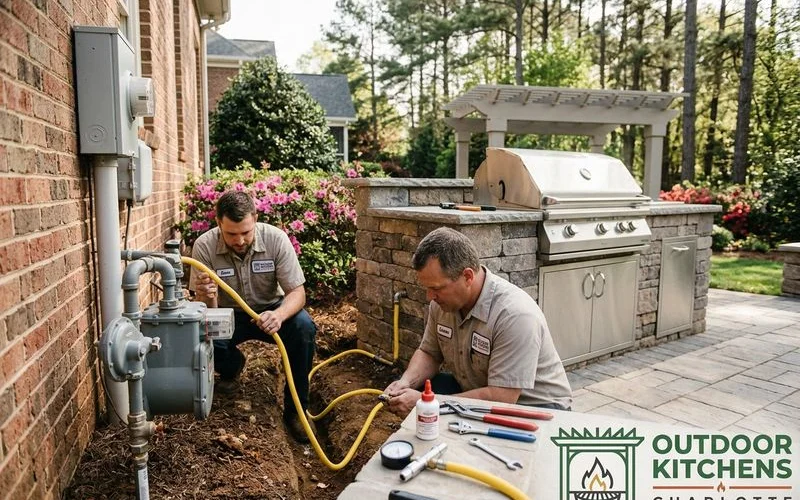
Your existing gas meter may not have enough capacity to handle the additional load.
We coordinate with Piedmont Natural Gas in Charlotte to verify capacity before running any new pipe. They may need to upgrade your meter or regulator if the outdoor kitchen demand exceeds the current limits.
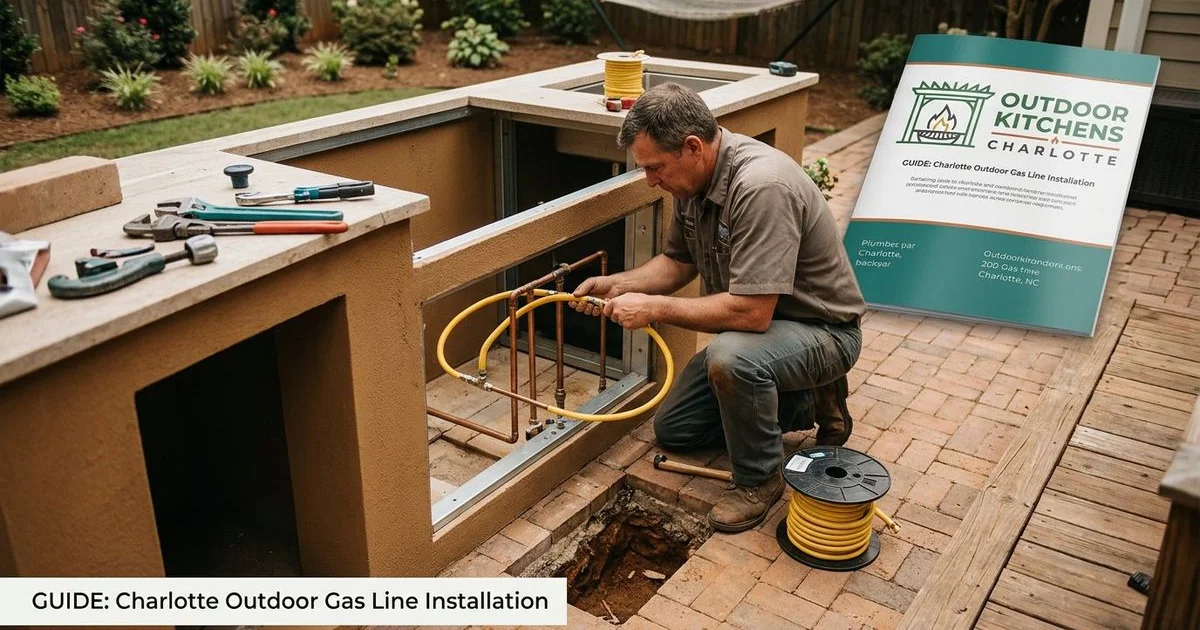
The gas line from your meter to the outdoor kitchen requires specific materials. We typically use yellow High-Density Polyethylene pipe for underground runs. This plastic pipe must be installed with a yellow tracer wire.
Utility locators cannot find buried plastic lines without that metal wire to scan. Our inside connections usually transition to black iron pipe or corrugated stainless steel tubing.
Pipe sizing depends directly on the distance and BTU load. Standard requirements include:
- Three-quarter-inch pipe: Suitable for a twenty-foot run with moderate demand.
- One-inch pipe: Required for a sixty-foot run with high demand.
- Larger diameters: Necessary for setups with multiple high-BTU burners running simultaneously.
Gas Line Safety Requirements
Gas line installation is strictly regulated and requires professional execution.
We exclusively use licensed mechanical contractors for all gas line work in Mecklenburg County. A permit and inspection are legally required before the line can be activated. A gas leak can cause explosions, fires, carbon monoxide poisoning, and even death.
Safety protocols start before the shovel hits the dirt. We always contact the 811 utility locating service three days before digging begins. This federal service marks existing public utility lines to prevent accidental strikes. Private locators must also be hired to find existing private lines on your property.
Our contractors install a master shutoff valve at the outdoor kitchen. This allows you to turn off gas to all appliances from a single point during an emergency. Each individual appliance should also have its own dedicated shutoff valve for maintenance. Quick-connect fittings make future servicing much easier.
Permitting and Pressure Testing
All gas connections must undergo a rigorous pressure test. We pressurize the system with air or nitrogen to 15 psi. The inspector will verify that the system holds this exact pressure for fifteen minutes with no drop.
Only after the pressure test passes can the county inspector approve the installation. Underground gas lines in Charlotte must be buried at a minimum depth of twelve inches.
We actually bury them at eighteen to twenty-four inches for added protection. The trench bottom must be clean and free of rocks that could pierce the plastic line. Our crews also lay yellow caution tape a few inches above the pipe. This warns future landscapers before their shovels hit the active gas line.
Planning Your Plumbing Installation
Adding a sink transforms an outdoor setup into a complete food preparation facility.
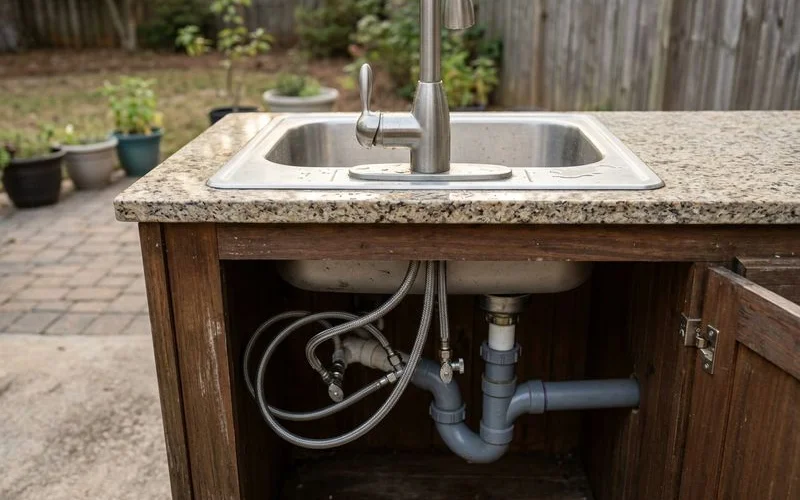
We highly recommend including a sink to save you from carrying dirty dishes back inside the house. Outdoor kitchen plumbing involves a hot water supply line, a cold water supply line, and a drain line.
Water Supply Line Materials
Connecting to your home water system requires tapping into an interior line. We route new pipes through the foundation or exterior wall out to the yard. Copper and PEX are the most common materials for these supply lines in Charlotte.
Our preferred material for new installations is Uponor AquaPEX. This specific PEX-A tubing is highly resilient in freeze and thaw cycles. It can actually expand up to three times its diameter without rupturing.
We always protect PEX from UV exposure because sunlight breaks down the plastic over time. Any above-ground runs need to be enclosed in a protective sleeve or conduit.
Managing Wastewater
The drain line is typically the most challenging component of the plumbing setup. We must connect outdoor kitchen drains to the municipal sewer system or an approved greywater system. Draining sink wastewater directly onto the ground is illegal in Charlotte.
Gravity drains require a very specific slope to function correctly. We pitch the drain line at exactly one-quarter inch per foot. This ensures wastewater flows naturally to the main sewer connection. Our designs use pumps if the outdoor kitchen is located downhill from the house.
We install Saniflo Sanivite or Saniswift Pro drain pumps for these low-elevation setups. A compact drain pump fits neatly inside the outdoor cabinet. These pumps can discharge greywater up to fourteen feet vertically to reach the main sewer line.
Winterization and Freeze Protection
Charlotte winters are generally mild but occasionally bring severe freezing temperatures.
We know that exposed water lines in an outdoor kitchen are extremely vulnerable to bursting. Burst pipes cause significant water damage and require expensive springtime repairs.
There are two primary approaches to freeze protection for outdoor plumbing. We often install frost-proof supply lines with shut-off valves located inside the heated house. You manually turn off the interior valve before the first hard freeze. Then, you open the outdoor faucet to drain the remaining water and leave it open until spring.
Our team recommends upgrading to frost-proof yard hydrants for added safety. Plumbers frequently use Woodford Model 17 or Model 22 hydrants. These units include specific protective features:
- A patented pressure relief valve to stop bursts.
- An automatic self-draining mechanism.
- Internal anti-siphon protection.
The second approach is to install automated heat-trace cable along the exposed water lines. We wrap the pipes in self-regulating heat tape from brands like Heat-Line or Frost King. This electric cable automatically adjusts its heat output based on the ambient air temperature. It keeps the water inside the pipe safely above thirty-two degrees.
Our crews finish the job by insulating all outdoor plumbing. Closed-cell foam pipe insulation traps the heat from the trace cable. Drain lines should also be designed to fully drain by gravity so standing water cannot freeze inside the P-trap.
Estimating Costs for Utility Installation
Utility costs are one of the most variable elements of an outdoor budget. We see prices fluctuate heavily based on the distance from your home to the kitchen location. The complexity of the trenching and the condition of your existing utilities also drive the final price.
As of 2026, running an underground gas line costs between $15 and $50 per linear foot in the US. We find that simple installations with easy access fall on the lower end. Complex projects that require tunneling under concrete walkways push the price higher.
Our data shows that a complete outdoor kitchen installation averages around $13,180 nationally. The utility portion makes up a significant percentage of that total.
Average Utility Installation Costs
| Utility Type | Estimated Cost Range | Key Cost Factors |
|---|---|---|
| Gas Line | $800 - $3,000 | Distance, meter upgrades, trenching difficulty |
| Plumbing (Sink) | $1,000 - $4,000 | Hot water extension, drain pump requirements |
| Electrical | $500 - $5,000 | Number of circuits, subpanels, landscape lighting |
A short, straight gas run from a meter already on the back of the house might cost under a thousand dollars. We expect higher costs for a long run across a patio to the far side of the yard. Hot water plumbing adds cost because you must extend a hot line or install a point-of-use water heater.
Coordinating Utilities With Your Kitchen Design
The time to plan your utilities is during the design phase. We finalize every appliance location, sink placement, and electrical outlet before any digging begins. Changes to utility routes during construction are expensive and cause major delays.
Our sequence of construction is very specific to ensure safety and efficiency. The drain lines go in first because they require the deepest burial and exact gravity sloping. Gas and electrical lines follow closely behind. We maintain a safe clearance of at least twelve inches between parallel utility trenches.
Professional outdoor kitchen installation contractors in Charlotte coordinate all utility work as part of the overall project plan. We work with licensed gas, plumbing, and electrical subcontractors to keep the job moving. The project manager schedules inspections at the appropriate stages.
Our main priority is to ensure that all utility connections are safely installed. Your new kitchen will be fully code-compliant and ready to use.
Next Steps for Your Outdoor Kitchen
The utility lines are the lifeblood of your outdoor cooking space.
We strongly advise finalizing these connections before pouring any concrete or building the island frame. Proper planning ensures your appliances perform perfectly and your property remains safe.
Your next step is to calculate the total BTU and water demand for your desired appliances. Our experts are ready to help you evaluate your current meter capacity and discuss trenching options.
Michael Carter
Outdoor Living Design Specialist
15+ years designing outdoor kitchens across Charlotte, NC.