7 Small Outdoor Kitchen Ideas That Maximize Your Space
Short on space? These 7 clever small outdoor kitchen designs prove you don't need a massive backyard to cook outdoors in Charlotte.
Sarah Reynolds
Many homeowners and business owners assume a stunning cooking area requires a sprawling backyard.
We hear this misconception every single week.
The reality is that smart design decisions easily compensate for limited square footage.
Our professional service team has transformed countless modest patios into culinary retreats. As trusted outdoor kitchen builders in Charlotte, we know that smart design beats raw square footage every time.
These 7 small outdoor kitchen ideas that maximize your space prove that bigger is rarely better.
We are going to break down the exact layouts, equipment choices, and specifications that make tight areas highly functional.
1. The Straight-Line Grill Station
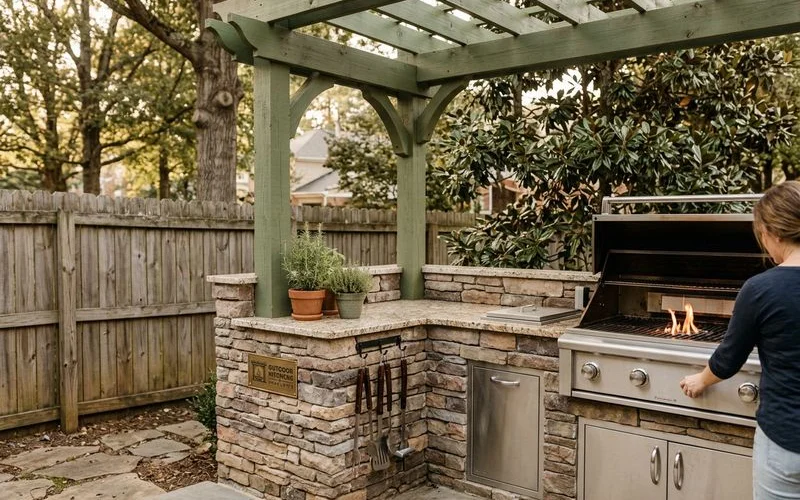
When space is tight, a linear grill station provides the most efficient layout available. Our team often recommends a 28-inch or 32-inch built-in gas grill from leading US brands like Blaze or Coyote to anchor the center. This specific sizing leaves crucial room for adjacent prep surfaces. We generally restrict the depth of these stations to about thirty inches from front to back. Narrow patios immediately benefit from this streamlined footprint.
Our favorite local projects in Charlotte neighborhoods like Plaza Midwood or NoDa use this approach against existing privacy fences. A small overhang provides essential protection from afternoon sun and summer rain showers. We always advise extending the countertop material at least twelve inches on each side of the grill head. This simple measurement gives you just enough room to set down a plate or rest your tongs safely.
| Grill Size Category | Ideal Application | Counter Space Required |
|---|---|---|
| 24-Inch to 28-Inch | Ultra-compact urban patios | Minimum 48 inches total width |
| 30-Inch to 32-Inch | Standard townhome decks | Minimum 60 inches total width |
Choosing the correct materials keeps a linear layout from feeling cramped. Our installers favor lighter-colored stone or quartz to make the single counter run appear larger than its physical dimensions. Adding a compact 15-inch outdoor-rated refrigerator to the end of the line reduces trips inside the house. We find this small addition drastically improves the actual cooking experience.
2. The Corner Kitchen
An L-shaped footprint uses dead corner space brilliantly. Our designers frequently adapt the classic indoor work triangle to fit this exact outdoor layout. Placing a compact drop-in sink on one arm and the primary cooking surface on the other keeps prep and grilling completely separate. We find this setup works exceptionally well for total patio areas under 200 square feet.
Corner configurations naturally create an open area in front of the cook. Our clients appreciate how the two arms provide a physical barrier between the hot grill and the socializing zone. This layout guides guests away from the flames safely. We always prioritize this specific flow when children or pets use the backyard regularly.
Strategic Zone Separation
Maximizing a corner requires intentional appliance placement. Our standard practice places the trash receptacle pull-out directly under the primary prep zone. This prevents the chef from constantly crossing the cooking area to throw away food scraps. We often tuck a narrow storage cabinet into the deepest part of the corner where reaching is difficult.
This deep storage pocket perfectly holds bulky items like bags of charcoal or spare propane tanks. Our team regularly utilizes the corner itself to house a built-in outdoor ice maker. The intersecting countertops provide an ideal beverage station completely separated from the high-heat grilling area.
3. The Rolling Cart Companion
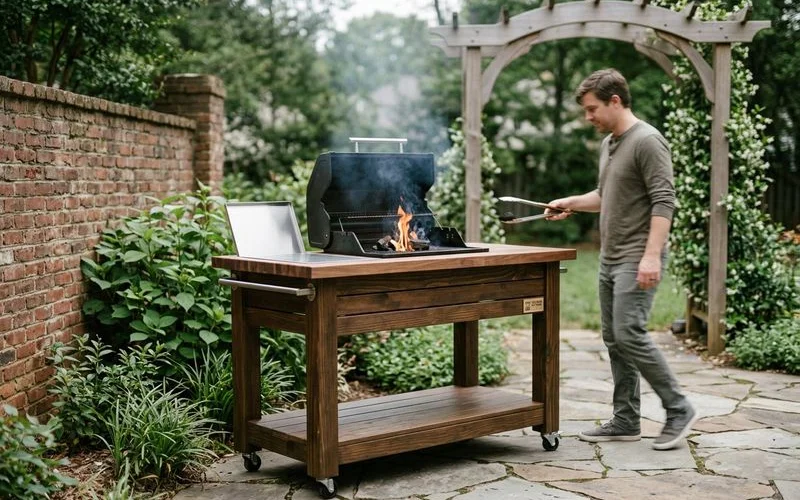
Sometimes the smartest small-space solution involves pairing a permanent anchor with a mobile unit. Our builders frequently deal with strict weight restrictions on raised wooden decks across the US. Standard residential decks typically support a live load of 40 pounds per square foot. We pair a modest four-foot permanent grill island with a mobile prep station to stay safely under these structural limits.
Heavy custom masonry structures often require expensive deck joist reinforcement. Our cost-effective alternative uses a stainless steel rolling cart like the Keter Unity XL for immediate prep space. The cart rolls entirely out of the way when you finish serving food. We highly recommend this hybrid strategy to give you back your full deck space for lounging or dining.
- Locking Casters: Heavy-duty wheels must feature locking mechanisms to prevent rolling while chopping vegetables.
- Food-Safe Tops: Look for carts featuring 304-grade stainless steel or thick butcher block surfaces.
- Weatherproof Storage: Ensure the lower cabinet has sealed doors to protect paper towels and tools from rain.
- Toweling Racks: Built-in side handles that double as towel bars save valuable top surface area.
4. The Vertical Storage Kitchen
Building upward is mandatory when you cannot spread out horizontally. Our outdoor designs regularly incorporate tall storage cabinets and overhead hanging racks to reclaim floor space. Selecting the right metal prevents premature deterioration in humid or coastal US regions. We always advise using 304-grade stainless steel shelving for standard climates and upgrading to 316 marine-grade steel if you live near saltwater.
Magnetic knife strips and pegboard panels clear your valuable prep surfaces entirely. Our installation crews ensure overhead storage sits at a safe height to prevent head injuries. Setting the bottom of upper cabinets at least 18 inches above the countertop is an industry standard that guarantees safe clearance.
Fold-Down Efficiency
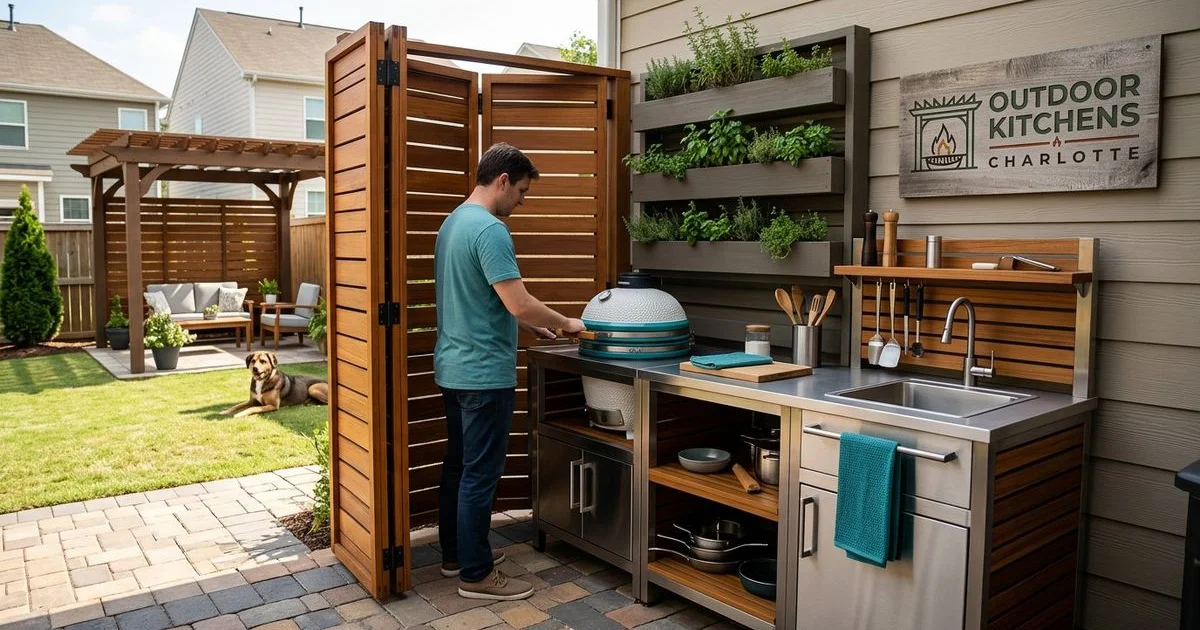
Vertical strategies pair beautifully with fold-down hardware. Our custom projects often feature a heavy-duty folding counter bracketed directly to an exterior wall. You lift the generous prep surface into place just before the cooking begins. We love how the entire station drops flat against the wall and nearly disappears when the meal concludes.
This drop-down mechanism works flawlessly under covered patios or screened porches. Our teams have retrofitted hundreds of Charlotte homes built from the 1950s through the 1980s with this exact space-saving feature.
5. The Built-In Kamado Setup
A kamado-style cooker offers the most versatile cooking capabilities for tiny spaces. Our clients consistently praise units like the Kamado Joe or Big Green Egg for replacing multiple appliances. A Large Big Green Egg weighs about 162 pounds but acts as a smoker, a grill, and a pizza oven simultaneously. We build these ceramic vessels into customized tables that require a footprint of less than six feet.
Safety is critical when recessing high-heat cookers into wooden or composite tables. Our installers enforce a strict two-inch air gap around the ceramic base to prevent surrounding materials from catching fire. Using a proper metal table nest under the kamado guarantees airflow and prevents heat transfer during long smoking sessions.
Year-Round Performance
The kamado cooking community is massive across the US because the insulated design performs perfectly in freezing weather. Our customers routinely smoke briskets for 18 hours in the dead of winter without losing internal temperature. Building the kamado into a permanent outdoor kitchen table elevates it from a standalone grill to a high-end architectural feature. We typically surface these custom tables with granite or concrete to withstand extreme weather year-round.
6. The Modular Prefab Kitchen
Prefabricated modular units have completely revolutionized tight-space renovations. Our project managers recommend factory-built modules from brands like NewAge Products to eliminate the delays associated with custom masonry work. These systems arrive fully constructed and bolt together in a matter of hours. We watch homeowners save thousands of dollars on labor costs while still achieving a premium built-in aesthetic.
Current 2026 pricing clearly highlights the financial advantage of modular systems. Our clients can purchase and install a high-quality three-piece modular setup for under $5,000. Custom masonry structures of the exact same size routinely start at $10,000 or more depending on local labor rates. We utilize these modular profiles specifically because they feature narrow depths and integrated quick-connect gas line hookups.
| Installation Type | Average US Cost (2026) | Typical Timeline | Renter Friendly? |
|---|---|---|---|
| Modular Prefab System | $3,500 - $6,000 | 1-2 Days | Yes (Can be unbolted) |
| Custom Stone/Masonry | $10,000 - $18,000+ | 3-6 Weeks | No (Permanent structure) |
Flexibility is a massive selling point in modern urban rental markets. Our installation teams can disassemble premium modular kitchens and relocate them when a client buys a new house. Renters in high-density areas finally have access to genuine outdoor kitchens without violating their lease agreements.
7. The Multi-Level Kitchen
Building on two distinct levels effectively doubles your usable surface area without stealing extra patio space. Our bi-level designs feature a lower tier housing the hot grill and a raised tier acting as a dining bar. The standard food prep counter sits at a comfortable 36 inches high. We elevate the dining tier exactly six inches to meet the standard bar height of 42 inches.
This subtle six-inch elevation change completely hides messy cutting boards and raw ingredients from your seated guests. Our designs establish a clear visual and physical barrier between the raw chicken and the cold beverages. We always enforce standard spacing rules for the seating area to ensure guest comfort.
- Stool Spacing: Allow exactly 24 inches of width per bar stool so guests do not bump elbows.
- Knee Clearance: The raised bar top must overhang the base structure by at least 10 to 12 inches.
- Heat Deflection: Ensure the grill hood has enough clearance to open fully without hitting the raised bar ledge.
- Targeted Lighting: Install low-voltage LED strip lighting directly under the bar overhang to illuminate the seating zone safely.
Two or three backless bar stools tucked entirely under the raised counter keep walkways completely clear. Our clients find this layout perfect for intimate entertaining where the chef remains part of the conversation.
Making the Most of Your Space
A small layout easily delivers the exact same enjoyment as a massive luxury build when executed correctly. Our primary advice is to prioritize the single cooking style you use most often rather than trying to fit every possible gadget into a tight corner.
We encourage you to choose space-efficient equipment, respect structural weight limits, and invest in durable 304-grade stainless steel.
If you want professional help maximizing a compact backyard, patio, or deck, explore our custom outdoor kitchen design services.
Our team specializes in creating functional, highly efficient spaces for properties of every size.
Some of our absolute favorite 7 small outdoor kitchen ideas that maximize your space have come from the tightest, most challenging blueprints.
Sarah Reynolds
Content Editor & Outdoor Living Enthusiast
Charlotte-based home improvement writer specializing in outdoor living.